“The sacrificial temple embodying ‘Heaven is round, Earth is square’ — The supreme architectural manifestation of ancient China’s philosophy of ‘harmony between man and nature’”
The Temple of Heaven Park lies in southern Beijing, east of Yongdingmen Inner Street in Dongcheng District, covering roughly 273 hectares. First built in the 18th year of the Yongle reign of the Ming Dynasty (1420), it underwent reconstruction and renovation in the Qianlong and Guangxu reigns of the Qing Dynasty. It was the venue where Ming- and Qing-dynasty emperors offered sacrifices to Heaven and prayed for bumper harvests. Its core selling point: unlike the Forbidden City, which represented secular imperial power, the Temple of Heaven embodied ancient people’s highest reverence for cosmic order. This grand temple complex was not built for human habitation, but solely for “dialogue with Heaven”. It is the architectural embodiment of ancient Chinese philosophy of harmony between humanity and the cosmos.
For overseas visitors, the Temple of Heaven captivates with its unique philosophical conception and acoustic wonders. Whether viewing the triple sapphire-blue glazed-tile circular roof of the Hall of Prayer for Good Harvests, or hearing soft whispers transmitted clearly along the Echo Wall, visitors gain vivid insight into ancient people’s cosmology of “round heaven, square earth” and their earnest longing for agricultural abundance. Twenty-two emperors of the Ming and Qing dynasties held 654 grand Heaven-sacrifice ceremonies here. Opened to the public as a park in 1918, it was designated a National 5A-level Tourist Attraction in 2007.
Architectural Layout — Round-North, Square-South Symbolism of Heaven and Earth
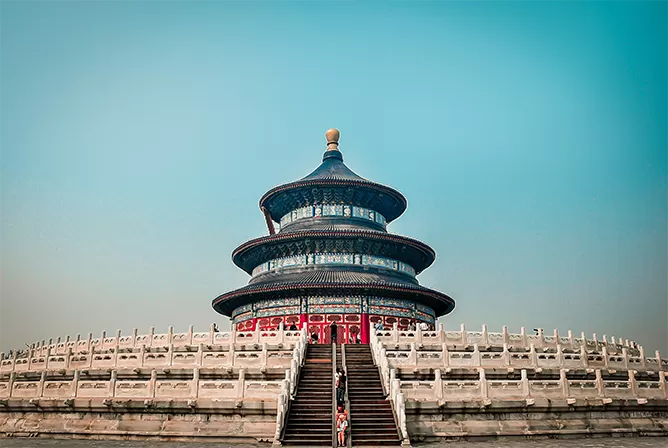
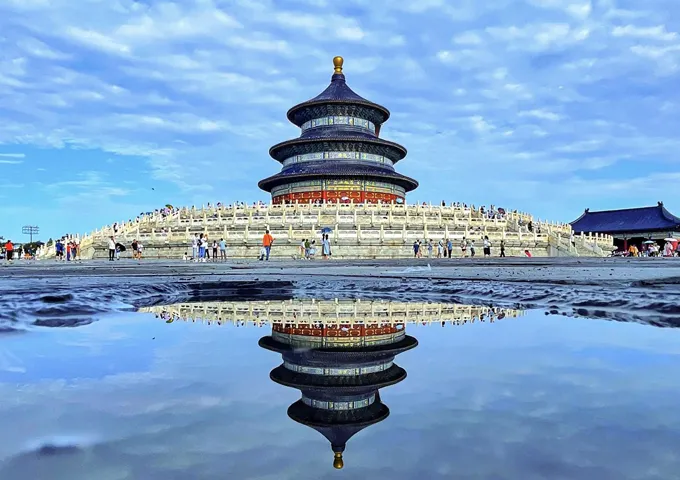
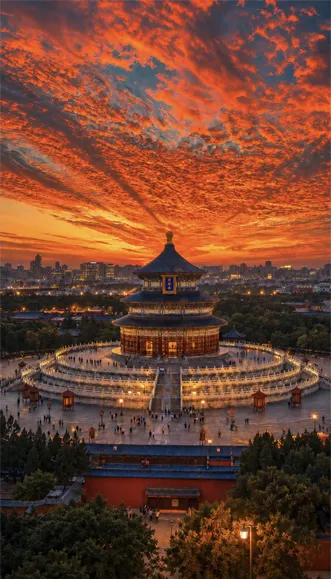
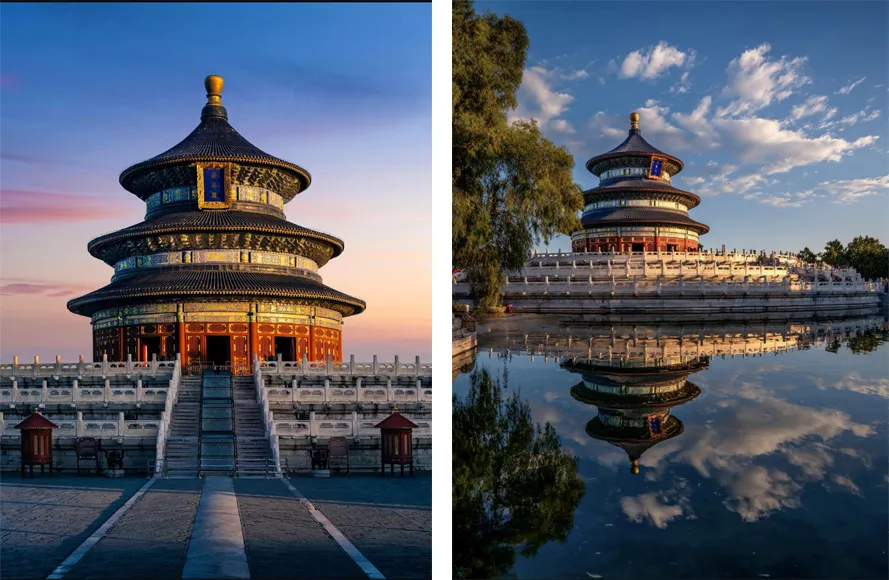
The Temple of Heaven features double surrounding walls: round in the north and square in the south, symbolizing “Heaven is round; Earth is square”. The compound is split into the Inner Altar and Outer Altar, with major buildings aligned along the central axis of the Inner Altar. At the northern end stands the Hall of Prayer for Good Harvests, where emperors prayed for spring sowing and abundant yields. Its triple-layered circular roof of deep-blue glazed tiles glows mysteriously in sunlight. Twenty-eight massive nanmu pillars inside symbolize respectively the four seasons, twelve months, twelve two-hour time periods, and the twenty-four solar terms, displaying consummate structural ingenuity. At the southern end sits the Circular Mound Altar, where emperors performed Heaven-worshipping rites on the Winter Solstice. It rises in three tiers; its altar surface, balustrades and steps are all multiples of the number nine, symbolizing “the Ninefold Heavenly Realm”.
Three key highlights of core buildings and acoustic marvels:
1. Hall of Prayer for Good Harvests: The landmark building of the Temple of Heaven. It measures 32.72 meters in diameter and 38 meters in height, crowned by a triple-eave circular roof covered in deep-blue glazed tiles. Its wooden framework is assembled without a single nail or iron fastener, representing the pinnacle of ancient wooden architecture.
2. Echo Wall & Imperial Vault of Heaven: The circular outer wall of the Imperial Vault of Heaven forms the famous Echo Wall. Thanks to its regular curvature, sound waves travel along the wall surface, so soft whispers spoken by two people far apart can still be heard distinctly — testament to extraordinary acoustic mastery of ancient craftsmen.
3. Circular Mound Altar & Heavenly Heart Stone: A three-tiered white marble altar. At its very center rests the Heavenly Heart Stone. Speaking softly while standing upon it, one’s voice seems magnified many times over, creating a sacred aura of “spiritual resonance between human and heaven”.
Sacrificial Rites and Imperial Ritual Codes
Every design detail of the Temple of Heaven serves one purpose: offering sacrifice to Heaven. In the pre-dawn hours of each Winter Solstice, the emperor, robed in blue sacrificial vestments, departed from the Hall of Abstinence to hold grand sacrificial rites at the Circular Mound Altar. The full ceremony strictly followed stipulations in the Collected Regulations of the Great Qing. Nine ritual procedures unfolded in sequence: welcoming deities, presenting jade and silk, offering sacrificial vessels, performing the First Libation, Second Libation, Final Libation, removing sacrificial offerings, sending off deities, and watching ritual burning. Every procedure carried the political-ethical principle of “revering Heaven and honoring ancestors”. The Hall of Abstinence was where emperors fasted for three days prior to ceremonies, to show sincere piety toward heavenly divinities. Today, visitors can still view sacrificial ritual implements, music and dance installations used in ancient ceremonies inside the Hall of Abstinence and the Divine Music Administration. These silent relics bear witness to an Eastern empire’s utmost reverence for cosmic order.
We use cookies to offer you a better browsing experience, analyze site traffic and personalize content. Part of the tracking is necessary to ensure SEO effectiveness, By using this site, you agree to our use of cookies. Visit our cookie policy to learn more.
 English

![[Kangyi Documentary] Summer Coolness Delivery, Warming Hearts on the Journey | Hangzhou Kangyi International Travel Service Pays Tribute to Every Guide Holding the Front Line](/uploads/images/we-are-committed-to-pursuing-excellence-and-striving_1772702268.webp "[Kangyi Documentary] Summer Coolness Delivery, Warming Hearts on the Journey | Hangzhou Kangyi International Travel Service Pays Tribute to Every Guide Holding the Front Line")
![[Kangyi Documentary] Under the Scorching Sun, True to Our Original Aspiration! Tribute to the Most Beautiful Tour Guides Holding Their Posts in the High Heat](/uploads/images/1_1772702274.webp "[Kangyi Documentary] Under the Scorching Sun, True to Our Original Aspiration! Tribute to the Most Beautiful Tour Guides Holding Their Posts in the High Heat")
![[Kangyi Documentary] Spectacular Scene! A 1,400-Person Group Tour of Jiangnan, Successfully Hosted by Kangyi International Travel Service!](/uploads/images/2_1772702280.webp "[Kangyi Documentary] Spectacular Scene! A 1,400-Person Group Tour of Jiangnan, Successfully Hosted by Kangyi International Travel Service!")