“The pinnacle of imperial gardens — A landscape scroll ‘crafted by humans, yet appearing wrought by nature’”
Located in Haidian District, Beijing, the Summer Palace is a World Cultural Heritage Site, a Major Historical and Cultural Site Protected at the National Level, and a National 5A-level Tourist Attraction. It ranks among China’s Four Great Gardens. Covering approximately 290 hectares, it is four times the size of the Forbidden City, with water surfaces accounting for three-quarters of its total area. Originally known as the Garden of Clear Ripples, its construction began in 1750. Burned down by Anglo-French allied forces in 1860, it was reconstructed in 1888 and renamed the Summer Palace. Its core selling point lies in its perfect integration of genuine mountains and waters with stately imperial-palace architecture. Blending the artistic conception of Chinese painting, poetry and literature, it embodies the grandeur of Chinese imperial gardens and stands as a rare masterpiece of garden art worldwide.
For overseas visitors, the Summer Palace is more than a park for strolling and sightseeing; it is a three-dimensional textbook on Chinese garden aesthetics. It draws inspiration from West Lake in Hangzhou and borrows landscaping techniques from Suzhou gardens. It merges the rolling terrain of Wanshou Hill with the vast expanse of Kunming Lake, unfolding a magnificent scroll that looks entirely natural despite human craftsmanship. As the best-preserved imperial retreat in existence, it bears witness to the turbulent late-Qing era and preserves historical traces of Empress Dowager Cixi and Emperor Guangxu.
Mountain-and-Lake Layout: Palaces amid shimmering hills and waters
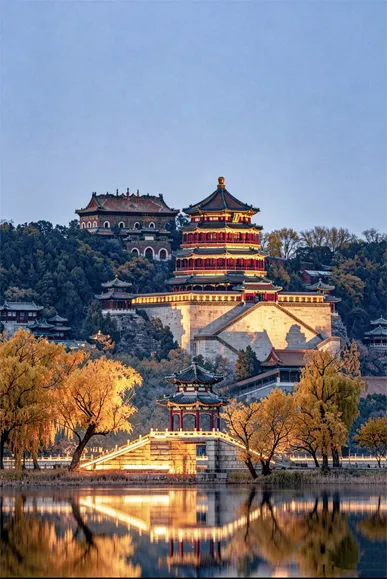
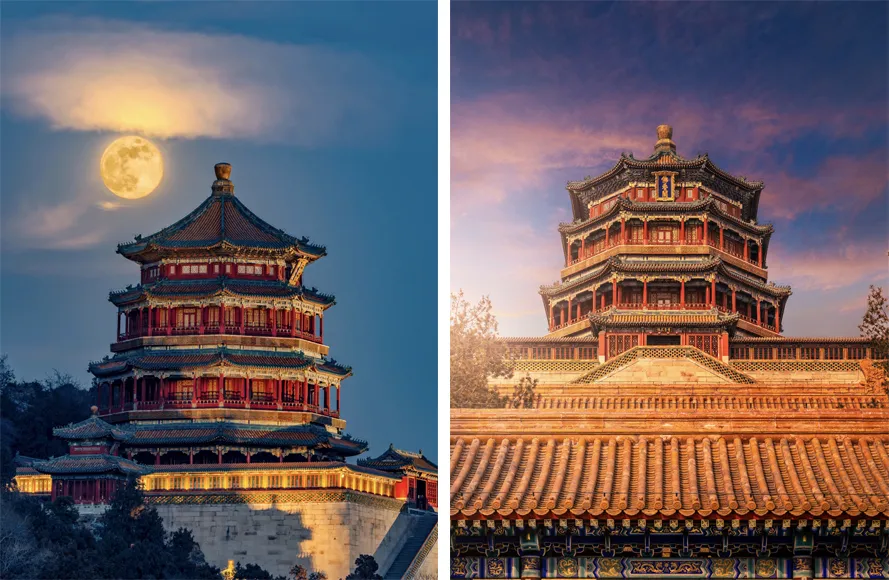
The Summer Palace creates a magnificent landscape by making full use of the expansive Kunming Lake and the undulating slopes of Wanshou Hill. The Tower of Buddhist Incense serves as the visual anchor of the whole garden, overlooking Kunming Lake to the south and backed by the Sea of Wisdom Temple to the north, forming a strong central axis. Kunming Lake occupies three-quarters of the park. Its broad, rippling surface is graced by the West Causeway, modelled on the Su Causeway of Hangzhou, dotted with six bridges that exude the charm of the Jiangnan water-town. Though not towering, Wanshou Hill features gentle rolling contours. The front slope centres on the Tower of Buddhist Incense, while the rear slope harbours quiet garden spaces including Suzhou Street and the Garden of Harmonious Interests. The front and rear slopes boast distinctly different styles and unique appeals.
Three core highlights among major buildings and scenic spots:
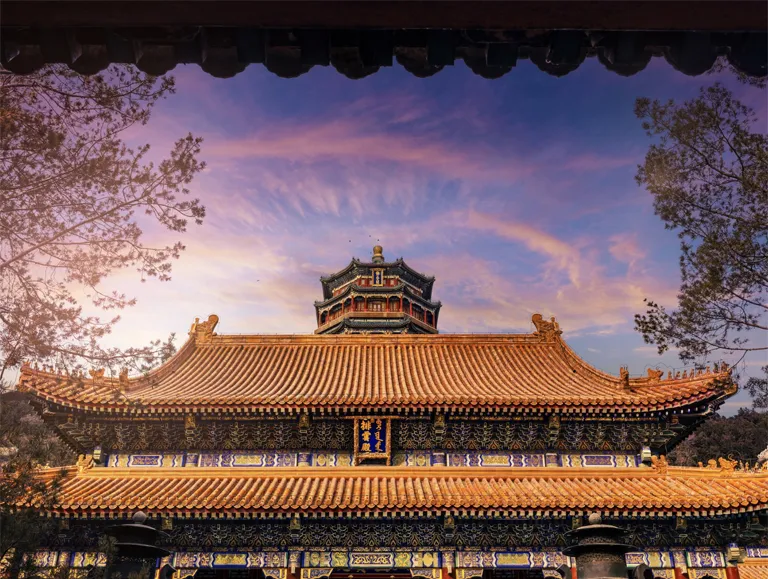
1. Tower of Buddhist Incense: The highest point across the whole garden, erected on a 21-metre-high stone terrace on the front slope of Wanshou Hill. This octagonal three-storey pavilion rises 41 metres. It commands sweeping southern views over Kunming Lake and stands backed by the Sea of Wisdom Temple. Inside sits a statue of the Thousand-Hand Guanyin. It is the visual centre and spiritual heart of the Summer Palace.
2. Long Corridor: Stretching 728 metres along the southern foot of Wanshou Hill, it is the world’s longest painted gallery. More than 14,000 Su-style coloured paintings adorn its beams and lintels, depicting landscapes, flowers-and-birds and scenes from China’s Four Great Classical Novels. Wandering through it feels like moving inside a painting.
3. Marble Boat (the Boat of Purity and Ease): Situated on the western bank of Kunming Lake. Its hull is carved from massive stone blocks. Its name evokes the wish “rivers clear and seas peaceful”, symbolizing enduring national stability. It is one of the most-photographed landmarks within the garden.
Stories of the Late Qing Dynasty: Traces of Cixi and Guangxu
The Summer Palace bears witness to the turbulent twilight of the Qing Empire. The Hall of Benevolence and Longevity was where Empress Dowager Cixi and Emperor Guangxu conducted state affairs. Its original furnishings remain intact: dragon desks, imperial thrones, folding screens, bronze cranes and bronze braziers silently recount that chapter of history. The Hall of Joyful Longevity served as Cixi’s residential quarters. The famed giant garden rock “Green-Green Jade” stands in its courtyard, and outside lies the dock from which Cixi set sail for lake cruises. After the failure of the Hundred Days’ Reform in 1898, Emperor Guangxu was long confined within the Hall of Jade Billows. Its interior layout and furnishings are preserved to this day. Every hall and every covered corridor bears witness to a dynasty’s struggles and choices between reform and conservatism.
We use cookies to offer you a better browsing experience, analyze site traffic and personalize content. Part of the tracking is necessary to ensure SEO effectiveness, By using this site, you agree to our use of cookies. Visit our cookie policy to learn more.
 English
![[Kangyi Documentary] Summer Coolness Delivery, Warming Hearts on the Journey | Hangzhou Kangyi International Travel Service Pays Tribute to Every Guide Holding the Front Line](/uploads/images/we-are-committed-to-pursuing-excellence-and-striving_1772702268.webp "[Kangyi Documentary] Summer Coolness Delivery, Warming Hearts on the Journey | Hangzhou Kangyi International Travel Service Pays Tribute to Every Guide Holding the Front Line")
![[Kangyi Documentary] Under the Scorching Sun, True to Our Original Aspiration! Tribute to the Most Beautiful Tour Guides Holding Their Posts in the High Heat](/uploads/images/1_1772702274.webp "[Kangyi Documentary] Under the Scorching Sun, True to Our Original Aspiration! Tribute to the Most Beautiful Tour Guides Holding Their Posts in the High Heat")
![[Kangyi Documentary] Spectacular Scene! A 1,400-Person Group Tour of Jiangnan, Successfully Hosted by Kangyi International Travel Service!](/uploads/images/2_1772702280.webp "[Kangyi Documentary] Spectacular Scene! A 1,400-Person Group Tour of Jiangnan, Successfully Hosted by Kangyi International Travel Service!")