"The Root of Shanghai – 600 Years of Urban Life – A Daoist Temple Honoring Three City Gods"
Shanghai City God Temple is located at 249 Fangbang Middle Road in Huangpu District, Shanghai, adjacent to Yu Garden, and is a Shanghai Municipal Cultural Relic Protection Unit. Its core appeal lies in this: this is not merely a Daoist temple, but the spiritual origin point of Shanghai as an international metropolis. Since the Ming Yongle era (1403–1424), when Shanghai County Magistrate Zhang Shouyue converted the Jinshan Shrine into the City God Temple, this site has served as the faith center and commercial heart of the old city, continuing for over 600 years.
For international visitors, the temple's allure lies in its unique "one temple, three city gods" configuration – Western Han Dynasty General Huo Guang, late Yuan/early Ming Shanghai worthy Qin Yubo, and late Qing national hero Chen Huacheng, three figures from different eras, all receiving incense here – an extremely rare phenomenon in Chinese city god worship. Together with the Lake Heart Pavilion and the Nine-Turn Bridge, the City God Temple forms the most recognizable cultural landmark of Shanghai's "old city."
II. One Temple, Three City Gods – A Rare and Unique Configuration
Shanghai City God Temple evolved from "one temple, one city god" to "one temple, three city gods."
Huo Guang – Western Han Dynasty General and Marquis of Bolu. The temple's predecessor was the Jinshan Shrine (also known as Huo Guang's Traveling Shrine), dedicated to this renowned Han Dynasty minister. When the temple was converted to a City God Temple during the Ming Yongle era, the tradition of enshrining Huo Guang in the front hall was preserved, creating the configuration of "Huo in the front hall, Qin in the rear hall."
Qin Yubo – A late Yuan/early Ming Shanghai native and a Yuan Dynasty scholar. Zhu Yuanzhang repeatedly summoned him to serve; he initially declined, but later entered official service to plead for the nation. After his death, Zhu Yuanzhang praised him, saying, "In life he would not serve as a minister; in death he shall defend the land." The people thus enshrined him as Shanghai's City God, hoping he would protect the city's peace. Qin Yubo is the primary City God of the temple.
Chen Huacheng – A late Qing national hero who died a heroic death defending the Wusong Fortress during the Opium War. The Qing Dynasty added him to the temple's worship to honor his loyalty and sacrifice, forming China's rare "one temple, three city gods" configuration.
Each of the three city gods has their own role – Huo Guang protects the city and its territory, Qin Yubo upholds justice and law, and Chen Huacheng embodies loyalty and patriotism – together guarding Shanghai's past and present.
III. Architectural Layout – Ming Dynasty Legacy of Southern Red Walls and Clay Tiles
The temple faces south, with its main buildings arranged along the central axis – the Main Gate, Second Gate, Theater Stage, Grand Hall, Rear Hall, and East and West Corridors – in a rigorously ordered layout.
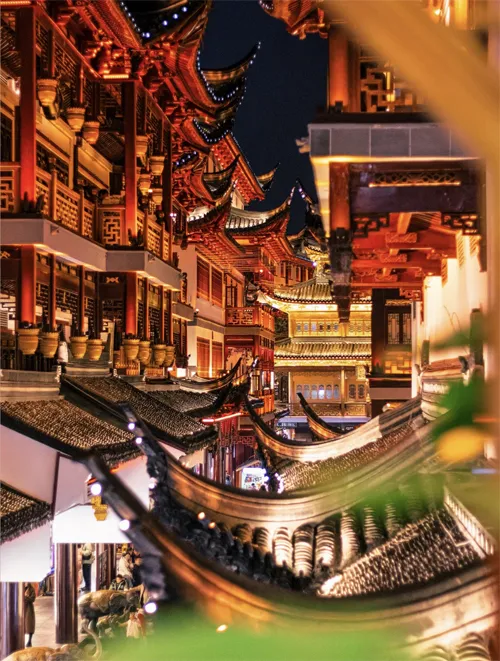
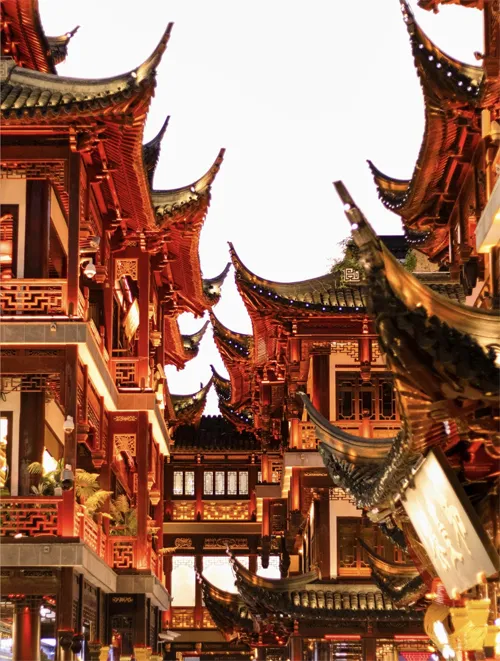
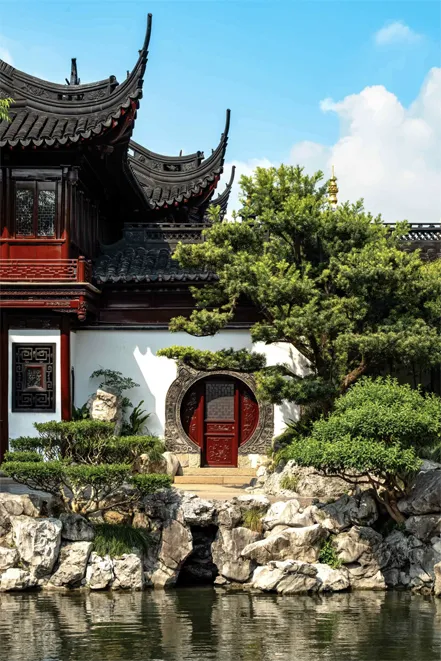
Architectural Style : The temple belongs to the typical southern grand-style architecture of red walls and clay tiles, predominantly in vermilion and dark green, with overhanging gable roofs, maintaining the Ming dynasty architectural style. The halls feature soaring eaves, intricate rafters, colorful beams, and green tiles with vermilion eaves, exuding solemn grandeur.
Nine Halls : The main buildings within the temple include 9 halls – the Grand Hall, Yuanchen Hall, Parents Hall, Guansheng Hall, Wenchang Hall, and others:
Grand Hall : A plaque reading "City God Temple" hangs above the main entrance. Inside sits the seated statue of General Huo Guang, Lord of Jinshan, flanked by the Civil Judge, Military Judge, Day Patrol, and Night Inspector divine officers
Yuanchen Hall (Hall of the Sixty-Year Cycle) : Enshrining the sixty Tai Sui deities of the sixty-year cycle; devotees pray here to their corresponding Tai Sui for blessings and protection
City God Hall : The main hall at the rear, with a red-faced wooden statue of Shanghai City God Qin Yubo seated in solemn dignity. The hall is furnished in the style of a Ming dynasty county magistrate's court, with full ceremonial regalia
Parents Hall and Lady Hall : Enshrining the City God's parents and his wife, Lady Chu
Wealth Hall, Cihang Hall, Wenchang Hall, and Guansheng Hall : Enshrining the God of Wealth, Cihang (Avalokitesvara), Wenchang (God of Literature), and Guansheng (Lord Guan)
It is worth noting that the Shanghai City God Temple Daoist Music Ensemble recorded China's first Daoist music tape, Welcoming the Immortal Guests.
IV. Nine-Turn Bridge and Lake Heart Pavilion – The Soul of the Old City
Though not within the temple gates, the Nine-Turn Bridge and the Lake Heart Pavilion together form the inseparable cultural identity of Shanghai's "old city."
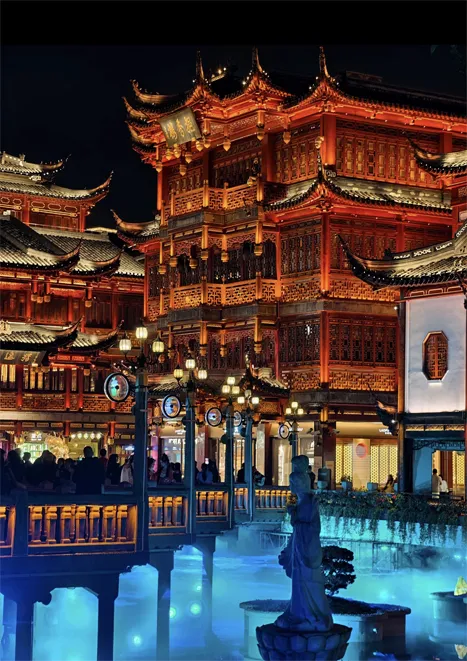
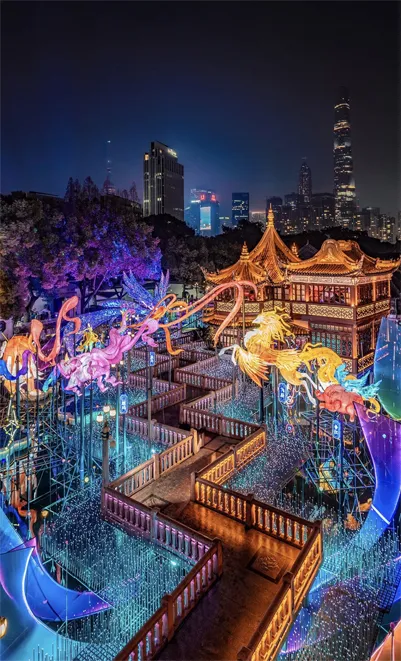
The Nine-Turn Bridge is known for its "nine turns and eighteen bends," making it one of Shanghai's most recognizable classical garden bridges. At nightfall, lanterns dot the bridge, their reflections shimmering on the water, creating a richly atmospheric scene.
The Lake Heart Pavilion sits at the center of the Nine-Turn Bridge. It is a T-shaped teahouse whose roof is composed of six spires and short-ridged gable roofs of varying sizes, featuring 28 corners arranged in pleasingly irregular fashion. This century-old teahouse is one of Shanghai's most celebrated places for tea drinking, and the visual focal point of the Nine-Turn Bridge.
V. The City God Temple by Day and Night
Day · A Reverent Daoist Sanctuary of Incense
Daytime is the best time to visit the temple halls and learn about Daoist culture. Visitors can enter the nine halls to observe up close the Ming-dynasty architectural details, the City God statues, and the furnishings styled after a Ming county magistrate's court. Devotees burn incense and pray here; amidst the swirling incense smoke, one can feel the faith tradition that has continued for six centuries.
Night · A Gilded Cyber-Dreamscape
After nightfall, the City God Temple transforms into a different realm. The upturned eaves and soaring corners become more vibrant under golden lights; golden light strings wrap around the vermilion pillars; traditional palace lanterns dance alongside LED neon lights. The Nine-Turn Bridge and Lake Heart Pavilion are reflected on the shimmering water, with "golden" ripples spreading across the lake. International tourists, local residents, children carrying lanterns, young people taking photos with their phones – people of different skin colors and languages gather here, forming a vivid modern-day Along the River During the Qingming Festival.
It is this blend of "sandalwood and latte" – this mixed aesthetic – that makes the City God Temple the "CBD of the Gods" – where contemporary meets tradition, and East meets West in a wondrous resonance.
VI. Yu Garden Lantern Festival – A National Intangible Cultural Heritage Celebration
The Yu Garden Lantern Festival is Shanghai's most celebrated traditional folk event, with a history dating back to the Qing Dynasty. According to the Yingruan Magazine published in 1875, on the night of the Lantern Festival, "pavilions near and far had lanterns outshining the stars."
In 2011, the Yu Garden Lantern Festival was listed in the third batch of China's National Intangible Cultural Heritage. In recent years, the festival has continued to innovate – in 2024, it featured the theme "A Fantastic Journey to the Mountains and Seas," creating a magical wonderland with AR interactive and digital human technology. In December 2023, the Yu Garden Lantern Festival made its international debut, lighting up simultaneously in Paris, France, and Shanghai – becoming a cultural highlight of the 60th anniversary of China-France diplomatic relations. The 2026 Lantern Festival plans to use "Going Home for the New Year" as its main theme, with lantern installations extending for the first time to Gucheng Park and the Bund.
We use cookies to offer you a better browsing experience, analyze site traffic and personalize content. Part of the tracking is necessary to ensure SEO effectiveness, By using this site, you agree to our use of cookies. Visit our cookie policy to learn more.
 English
![[Kangyi Documentary] Summer Coolness Delivery, Warming Hearts on the Journey | Hangzhou Kangyi International Travel Service Pays Tribute to Every Guide Holding the Front Line](/uploads/images/we-are-committed-to-pursuing-excellence-and-striving_1772702268.webp "[Kangyi Documentary] Summer Coolness Delivery, Warming Hearts on the Journey | Hangzhou Kangyi International Travel Service Pays Tribute to Every Guide Holding the Front Line")
![[Kangyi Documentary] Under the Scorching Sun, True to Our Original Aspiration! Tribute to the Most Beautiful Tour Guides Holding Their Posts in the High Heat](/uploads/images/1_1772702274.webp "[Kangyi Documentary] Under the Scorching Sun, True to Our Original Aspiration! Tribute to the Most Beautiful Tour Guides Holding Their Posts in the High Heat")
![[Kangyi Documentary] Spectacular Scene! A 1,400-Person Group Tour of Jiangnan, Successfully Hosted by Kangyi International Travel Service!](/uploads/images/2_1772702280.webp "[Kangyi Documentary] Spectacular Scene! A 1,400-Person Group Tour of Jiangnan, Successfully Hosted by Kangyi International Travel Service!")